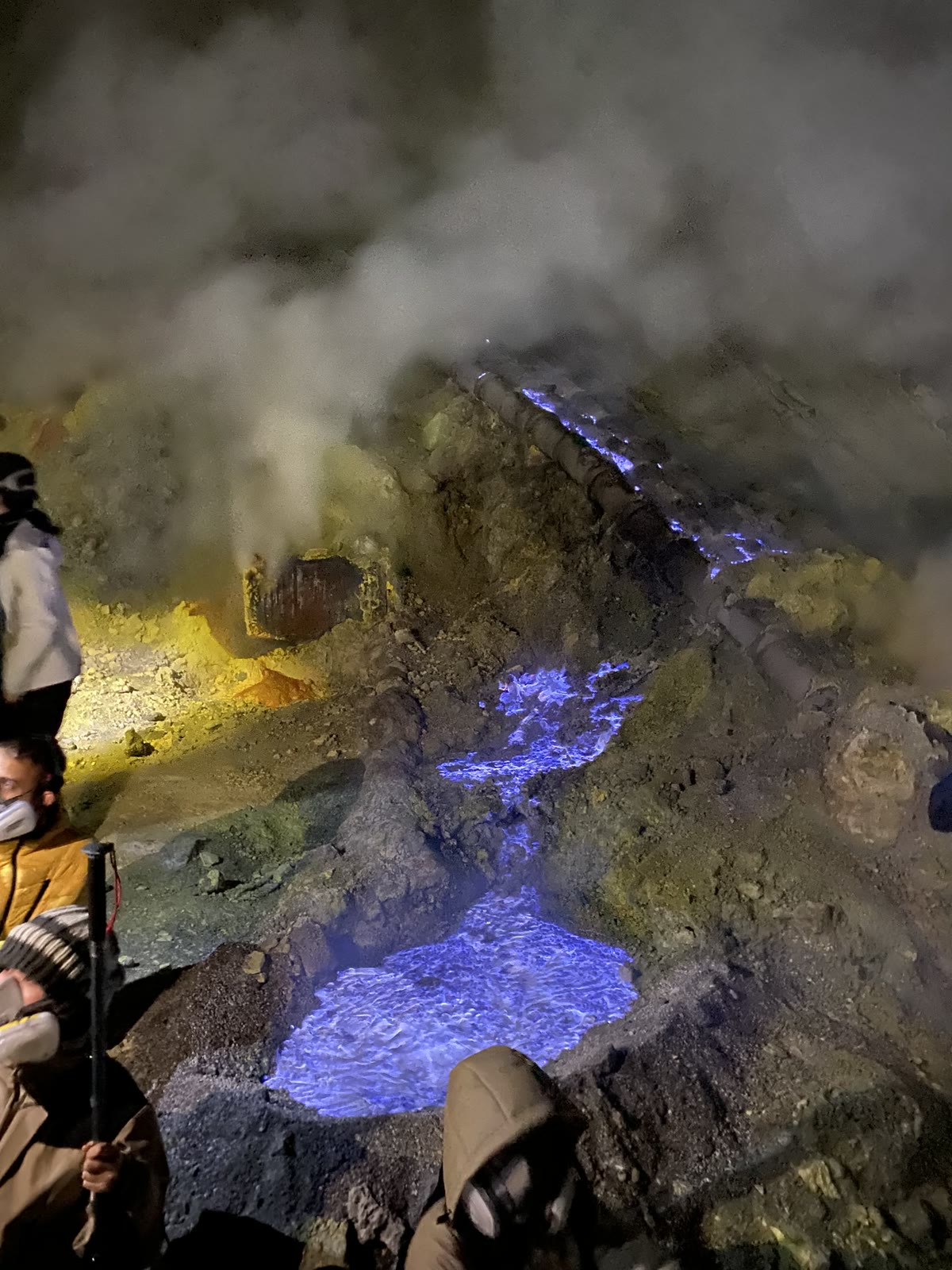
Most people who see Ijen blue fire photos online assume there's a filter involved. There isn't. The blue fire is real — sulfuric gases combusting at the crater vents, burning electric blue in total darkness before dawn. It's one of the genuinely strangest things I've watched, and I've watched it many times.
But I should also be honest about Ijen, because some tour operators aren't.
What the blue fire actually is
Kawah Ijen is an active volcanic crater lake on the border of East Java, near Banyuwangi. The lake is the world's largest acidic crater lake — pH around 0.5, close to the acidity of car battery acid — and it's a remarkable pale turquoise color in daylight.
The blue fire comes from sulfuric gases seeping up through the crater vents and igniting on contact with the air. It only burns visibly in darkness. By 5:30am, when the sky starts getting light, the blue disappears completely. You have a window of roughly two hours, starting around 2am. Get there after 4am and you'll see smoke but no blue.
How hard is the hike — honestly
Harder than most tour descriptions say. The trail from the Paltuding parking area to the crater rim is 3km and climbs about 600 meters. It takes most people 60-90 minutes. The first third is fine. The last kilometer is steep, the path is rocky, and it's all done in darkness with headlamps. People with knee problems find the descent harder than the ascent.
Then there's the optional descent into the crater itself to see the blue fire up close. This is genuinely difficult — a 45-degree slope, loose rocks, and sulfuric gas thick enough to burn your throat. You need a gas mask. The basic N95-style respirators that porters hand out at the trailhead are fine for most people. If you have respiratory conditions, bring a proper half-face respirator.
Without a mask: eyes water, throat burns, breathing hurts. Don't skip the mask.
The sulfur miners
Nobody prepares you for this part. At the crater floor, men are mining solid sulfur from the vents — breaking chunks loose with iron bars, loading them into wicker baskets, and carrying loads of 70-90kg back up the crater path and 3km out to the weighing station. They do this twice a day. Most earn less than $15 per trip.
The baskets cut into their shoulders through makeshift padding. The sulfur exposure causes serious long-term respiratory damage. Most miners develop health problems within a few years of starting the work.
Passing them in the dark while they work, these men carrying those impossible loads past tourists in Gore-Tex jackets — it stays with you. Many of our guests say this is the most memorable part of the trip, not the blue fire itself.
Is Ijen dangerous
There are real risks. The crater has had phreatic eruptions — sudden steam blasts with no warning. The last major one was in 2011. The park monitors volcanic activity and closes the trail when risk increases. Day-to-day, the main risks are the sulfur gas and the uneven terrain in darkness. Both are manageable with the right preparation.
Wear sturdy shoes with ankle support. Bring a headlamp. Don't wear contact lenses near the gas vents. Don't go in sandals. These aren't warnings for dramatic effect — they're things that actually matter on the trail.
Timing and getting there
The parking area is at Paltuding, about 2 hours from Banyuwangi. Arrive there by 1am to reach the crater in time for blue fire. That means leaving Banyuwangi around 11pm or doing an overnight stop at the gate.
From Yogyakarta, Ijen is 10-11 hours by road. Most people do it as part of a Bromo-Ijen trip — 3 nights combining both volcanoes. This is the most efficient way and what we'd recommend to most travelers. See our Bromo-Ijen combined tour from Yogyakarta.
Is the blue fire worth it
For most people, yes. There's nothing else like it in the world. Two active volcanic sites produce visible blue fire — Kawah Ijen in Java and a much smaller one in Iceland. The combination of the blue flames in total darkness, the turquoise lake at sunrise, the sheer strangeness of the place — Ijen delivers something you won't see anywhere else.
It's not comfortable. You're hiking in the dark, in the cold, breathing sulfur. That's also exactly what makes it memorable. The easy trips rarely are.
Ready to explore Indonesia?
Let Florish craft your dream journey.